
Autonomous Mobility and The Adaptive City
Executive summary
Autonomy is arriving faster than cities can govern it. This is what that costs, and what closes the gap.
In May 1938, Popular Science Monthly magazine introduced Dr. Miller McClintock, director of the Harvard University Bureau for Street Traffic Research, as “the nation’s foremost authority on traffic problems.” McClintock offered a startling prediction: in a near future, electric signals would “take over steering altogether – allowing the driver to release the wheel, sit back, and make himself comfortable until he chooses to switch back again to manual control.”
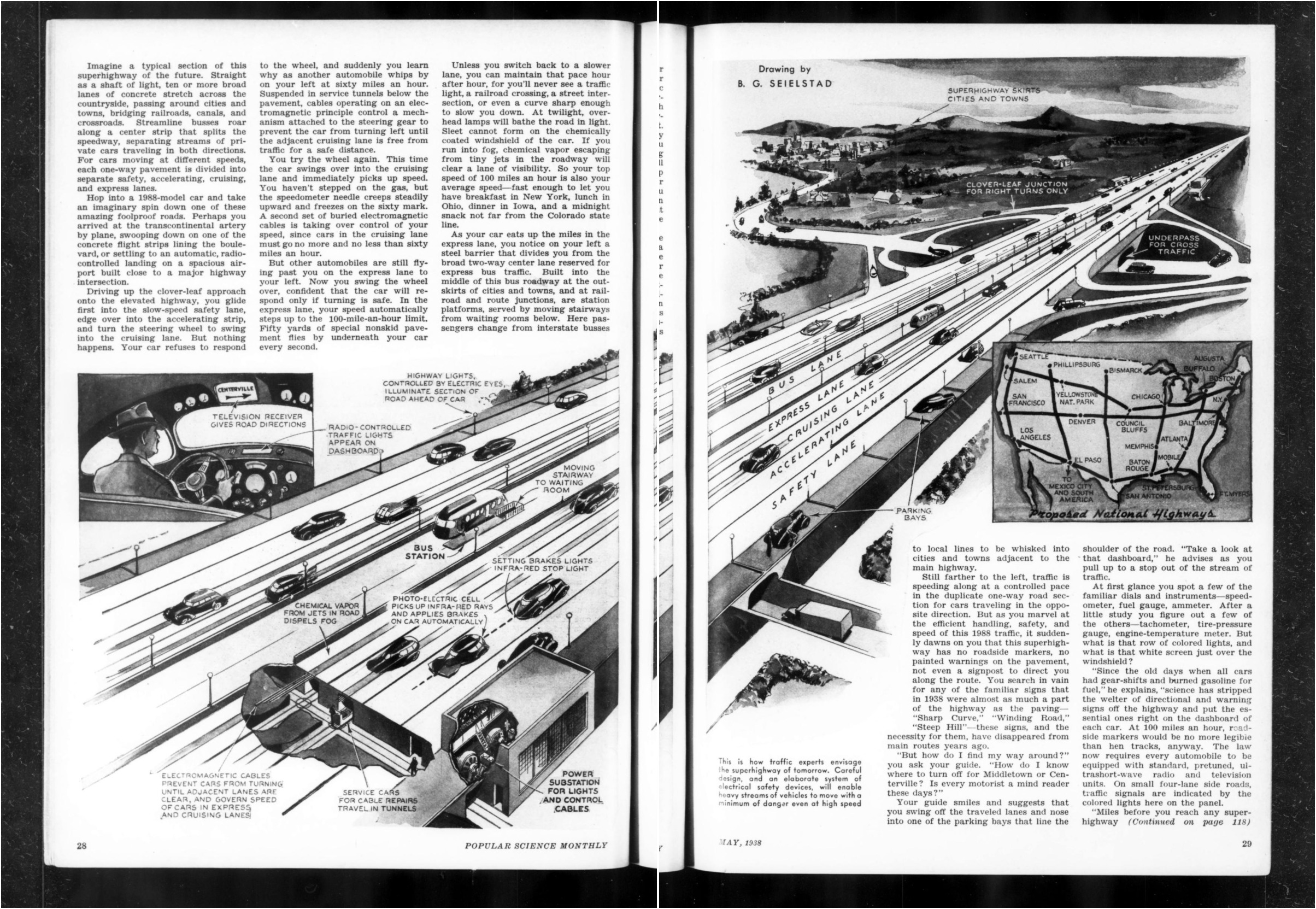
For nearly a century, autonomy has been just around the corner. It is no surprise, then, that the professionals doing the hard daily work of designing, managing, powering, regulating, and investing in the built environment have become deaf to hollow predictions.
And yet the authors are putting the finishing touches on this white paper in the quiet back seat of a Waymo self-driving car. Outside the window, a delivery bot trundles along the sidewalk, leaving a tangle of tourists, sidewalk diners, and a wheelchair user in its wake. Investors are signing checks for companies offering intermodal robotics, autonomous freight, and last-mile drone delivery.
Waymo has reached an impressive scale. In March of 2026, the service offered 500,000 paid rides per week, across a footprint of more than 1,400 square miles in more than ten US cities.
It’s easy to agree that autonomy is important, but difficult to create a line item in the City budget or a staff position focused on self-driving cars. Spending is frozen, senior convening capacity is a scarce resource, and competing priorities like Vision ZeroVision ZeroThe road-safety commitment to eliminate traffic deaths and serious injuries. Cited as the archetype of a competing municipal priority that is clear, actionable and measurable — which is exactly why autonomy struggles to win budget and attention against it. (Ch.1.) are clear, actionable, and measurable.
For decades, autonomous vehicles have been caught between science fiction and science fact. Today, while operators deploy in cities around the world, governance is falling through the cracks between city and state, between transportation and mayor’s office, between long-term strategy and immediate decisions.
The Vehicle is a Distraction from Governance
When a technologist designs an autonomous vehicle, they also define very specific conditions under which that vehicle is safe to operate – what they call the technical Operational Design DomainODD (Operational Design Domain)The set of conditions under which an automated driving system is designed to operate — geography, weather, road type, time of day, speed envelope. An engineering construct: it answers where the vehicle can drive. (Ch.2, Box 2.1.) (ODD). It might specify, for example, highways versus surface roads, or snowy and icy conditions. The ODD matters, of course, but the impact autonomous vehicles have on communities will be the result of factors that are very far outside of the ODD’s scope.
To date, no one has defined the institutional conditions under which a vehicle is safe to operate: we call it the institutional ODDInstitutional ODDThe governance counterpart to the technical ODD: the conditions a city has to put in place — in rules, instruments, sensing, and authority — for CAM to operate inside its boundaries on terms the city can live with. Answers where the city can govern. (Ch.2, Box 2.1.) (iODD). The concept encompasses whether a city has the authority, the information and the oversight to govern what arrives on its streets. This paper is about the iODD.
The Institutional ODD and the Governability StackGovernability StackThe four-layer model the paper uses to organise what cities must govern: Flows (movement), Space (kerb, road, depot), Power (grid and energy), Data (sensing and authority). Each layer has its own institutional surface and timescales. (Ch.3.) are one matrix read two ways: the iODD scores a city across four domains – Flows, Space, Power, and Data – and the Stack sets out the four kinds of instrument – Sensing, Rules, Economics, and Design – that work across them. One diagnostic, one toolkit, one action plan.
Public sector action on urban autonomy is happening primarily at the state and federal level. Federal automotive safety rules have nothing to do with curb access rights, depot siting, grid connection and load balancing, equitable service obligations, incident escalation, or data access – but these are the fundamental issues that will characterize the lived outcomes of urban autonomy for cities and their residents. In several jurisdictions, state-level preemptionPreemptionWhere a higher tier of government removes a lower tier’s authority to regulate a subject. Texas SB 2807, making the operator a state licensee, is the paper’s worked example: a city can lose the power to set conditions without losing any obligation to absorb the consequences. (Ch.2.) is actively removing municipal authority – Texas SB 2807 makes the operator a state licenseeEV107EV107Texas SB 2807 Authorisation Enforcement Begins 28 May 2026; Only 6 of 10 Major AV Operators Authorised as of 20 April; Nuro, Zoox, Tesla Outstanding — 12 May 2026Operator-as-licensee model contrasts with California vehicle-as-permitted; serious-bodily-injury enforcement trigger; four major operators face cliff…Open in the Evidence Base → – but the operational consequences land on Texas’ cities, regardless. A city can lose the power to set conditions without losing any of the obligation to absorb the implications.
This paper does not make the case for a radical reprioritization of public sector time and budgets. Instead, it targets the gap between long-term strategy and immediate decisions, arguing that the normal, everyday choices being made in city halls, real estate firms, grid utilities, and state houses this year will define the future of autonomous mobility. Most don’t look like issues of autonomous mobility; they look like zoning or sidewalk permitting or grid infrastructure management.
Municipal governments will be accountable for positive or negative changes in the urban experience as autonomous fleets are deployed, and they have a shrinking window to build the instruments they need to govern fleets effectively.
The Window Closes
Whether a city can govern urban autonomy has little to do with its size or its budget. It depends on whether the governance instruments were built before the vehicles arrived in earnest. Conditions set before operators enter are operating requirements; conditions imposed after they scale are regulatory burdens – to be contested in bitter and expensive legal battles.
Several of these decisions are a one-way street. The terms of the first operating licenses become the baseline for every subsequent negotiation. The choice of location for charging and idling depots will establish fleets’ spatial operating patterns and the development of new electricity grid infrastructure. And the information asymmetry between operators and cities compounds every day. The governance window is still open, but it is closing quickly.
The Value at Stake
Cities stand to gain or lose across five distinct but interrelated levers. For each lever, public and private sector entities have specific instruments they can use to mitigate loss and capture value.
| LEVER | VALUE AT RISK | VALUE TO GAIN | INSTRUMENT |
|---|---|---|---|
| FISCAL | Parking revenue and enforcement. | Transaction- and deployment-fee model scaled to operator activity. | Licensing conditions or operating contracts. |
| ENERGY | Grid overload, resulting in blackouts, brownouts, or rate increases. | Grid stability, reduced per-mile energy cost for operators. | Demand-side charge managementManaged chargingShaping when a fleet charges so that demand falls outside network peaks, in exchange for lower cost or faster connection. The mechanism behind the paper’s "fleet as a battery" framing: a controllable load is an asset to the grid rather than a threat. (Ch.2.) frameworks; fleet-as-a-battery protocols. |
| REAL ESTATE | In low-density markets: stranded parking assets. In high-density markets: scarce, contested operational land. | In low-density markets: reliable business model for building assets (publicly or privately owned). In high-density markets: land assembly with explicit operational-use trade-off frameworks. | Conversion-ready design specifications embedded in planning policy; zoning protections and explicit allocation rules for operational land. |
| SPATIAL ALLOCATION | Curb capture by fleet operations; gridlock during events; threats to vulnerable road and sidewalk users. | Dynamic curb pricing and management; seamless operation during peak use; safety and equity. | Digital curb management platform; flexible operating conditions that protect vulnerable users and prioritize first response. |
| LEGITIMACY | Backlash and political prohibition; tension with labor unions. | Visitor experience; positive press; durable public license to operate; workforce transition instead of conflict. | Public demos; workforce transition programs; operational transparency; community benefit agreementsCommunity benefit agreementA negotiated commitment from an operator or developer to deliver specific local benefits in exchange for permission to proceed. One of the three named instruments for the paper’s legitimacy lever, alongside mandatory transparency and structured workforce transition. (Ch.6.). |
This table makes two things clear. First: the same technology can generate either outcome, positive or negative. Second: the instruments at hand are not complex. Each is well within the grasp of public administrations and their private sector collaborators. The outcomes of autonomy will be the consequence of governance models that cities choose to build, or accept by default.
The fastest way through institutional inertia is to price inaction. In the case of urban autonomy, we estimate the cost of delayed governance in the billions for large cities, with proportional amounts at risk in smaller ones.
| City archetype | Early governance (2026–27) | Delayed governance (2028–29) | No governance |
|---|---|---|---|
| Global city (8m+) e.g. New York, London | $2.5–5bn/yr; fiscal stability; competitive corridor premiums 6–12% | $0.6–2bn/yr; partial capture; fiscal erosion under way; retrofit costs double | Net fiscal loss $1.3–2.5bn/yr; transit under stress; unmanaged congestion; political backlash likely |
| Large regional (1–4m) e.g. Chicago, Toronto, Manchester | $250–750m/yr; depot coordination; transit agency-operator integration; managed grid load | $60–250m/yr; fragmented deployment; operator-led siting; grid stress emerging | Revenue loss $125–500m/yr; stranded parking assets; service gaps in lower-income areas |
| Mid-size (250k–1m) e.g. Portland, Austin, Bristol | $40–125m/yr; pilot-led learning; conversion-ready design; first-mover corridor advantage | $12–50m/yr; reactive adaptation; missed corridor advantage; grid bottlenecks | Net negative; parking revenue collapse without replacement; operator-defined terms |
Taking Action: the first 90 days
Chapter 8 sets out an action plan sequenced by dependency. Actions are broadly sequenced on three horizons: 90 days (taking easy, reversible first steps); 12 months (building capacity); 3-5 years (institutionally mature operations). Each phase establishes the institutional conditions the next one requires.
The first step is diagnostic. Scoring the iODD gives cities a baseline against which they can measure every subsequent reform. From there, the 90-day plan focuses on actions with low institutional cost that set a strong precedent. Building on the established data frameworks of micromobility and ride hailing services, a city can stand up its Minimum Viable Operating PictureMVOP (Minimum Viable Operating Picture)The minimum sensing and intelligence capability a city needs to govern CAM credibly: the smallest combination of data feeds, schemas, and analytical capacity that lets the city see what is happening across its territory and act on it. Sequenced over time toward a full operating picture. (Ch.5 §5.3.) (MVOP): the smallest set of capabilities that enables the most critical governance instruments to function. Minimum viable, so that a city with limited resources and limited political bandwidth can capture the most governance value early and build toward the full operating picture over time. The MVOP convenes multiple agencies around a cross-agency governance protocol, and brings operators to the table early for a conversation about shared objectives.
Regret is Asymmetric
From our vantage point in 2026, it is easy to imagine policies, pilot structures, and data agreements that would have transformed the rollout of Uber or Airbnb. In 2015, any one of them would have cost a few staff-weeks. Over a decade later, issues are settled with difficult battles in court, costing millions and fracturing public trust.
At this moment in the diffusion of autonomous vehicles, regret is asymmetric. A city that takes action and turns out to be wrong about urban autonomy has lost a few staff-weeks building capacity it needed anyway. A city that waits and turns out to be wrong will retrofit governance from a weak position, fighting for every inch of regulatory space against fleet operators already embedded and running based on terms set elsewhere.
The remaining work is institutional, not technological, and it can begin now, under existing frameworks and authorities. The rest of this paper sets out the instruments, the sequencing, and the precedents for decisive, cross-sectoral, multi-jurisdictional action on urban autonomy.
This paper is the first output of the Urban Autonomy Lab, a Field Discovery research program that convenes cities, operators, utilities, and investors to design and evaluate pilot governance for autonomous mobility.