
The Pacing Problem
Path dependency, unknowability, and the case for acting now
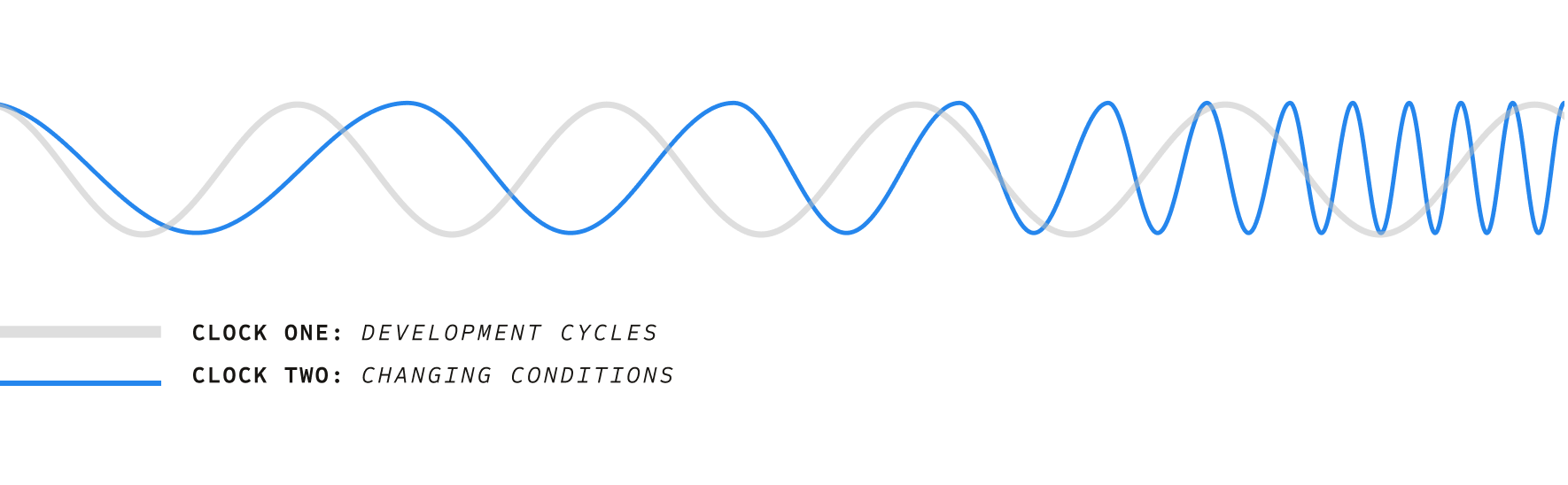
1.1Two clocks
The institutions that govern cities were designed for an era when the most consequential changes to urban operating systems took decades. None was calibrated for a technology whose commercial trajectory can shift by orders of magnitude in months.
Waymo launched commercial service in Phoenix in 2020, San Francisco in 2022, Los Angeles in 2024, and Austin in 2025. Its paid rides grew fiftyfold in under three years, from roughly 10,000 a week in May 2023EV06EV06CAM Deployment Fact PackWaymo ~2,500 vehicles across five US cities, 450,000 weekly rides by December 2025; China 20+ cities in L4 trials, Europe lagging deployment but not…Open in the Evidence Base → to more than 500,000 by March 2026. Autonomous cars crossed from demonstration to commercial service faster than almost anyone in city government predicted.
Planning authorities, transport agencies, utility regulators, and licensing bodies move at a very different pace. A city that decides today to build a commercial-scale electric vehicle (EV) fleet depot in an inner urban location faces a process that can span 18 to 36 months before a single vehicle can charge. The process encompasses planning consent (including potentially contested public hearings), grid connection application and assessment (nine to 12 months in the UKEV18EV18Grid Hosting Capacity Constraints for Depot-Scale EV ChargingGrid hosting capacity limits depot-scale EV charging; utility upgrade timelines, interconnection queues, and demand charges create fleet…Open in the Evidence Base →, longer in the US), civil engineering, utility infrastructure deployment, construction, and commissioning. Most inner-city infrastructure projects are hotly contested – in these cases, the slow process of consensus brings the realistic figure closer to three years, and the company building Waymo’s own depots reports 36 to 48 months or longerEV3279EV3279Voltera acquires urban real estate to build robotaxi charging depots, exposing fragmented zoning and power infrastructure as a systemic bottleneckVoltera (Palo Alto, Waymo partner), 10 depot sites, ~400 stalls, 37MW operational Jan 2026; double in development; 36–48-month utility timelines…Open in the Evidence Base → where substation upgrades are needed.
The US grid interconnection queueInterconnection queueThe waiting list for connecting new load or generation to the electricity grid, and the reason grid timelines are measured in years. The paper treats connection lead time — fifteen to eighteen months for a depot — as a hard constraint rather than an administrative delay. (Ch.1.) now holds approximately 2,300 gigawatts of generation and storage projects, with a median connection time of nearly five years for projects completed in 2023 and 2024.EV02EV02Grid Interconnection Queue Timelines, US + UKUS grid interconnection queues average 5+ years; UK connection delays similarly chronic; bottleneck threatens EV charging, AV fleet electrification…Open in the Evidence Base → Political will alone cannot fast-track a project through the queue. Timing reflects the physical and engineering realities of connecting new loads to a distribution network that was designed before the reality of large-scale transport electrification.
Zoning and development plan amendments take two to five years. Traffic regulation orders, required for even modest curb changes, take six to twelve months through a standard council process. Fiscal planning – such as budgeting for replacement revenue streams as parking income declines – operates on annual cycles that do not naturally anticipate discontinuous technological shifts.
These timeframes are a good indicator of how long it would take to implement the kinds of institutional reforms that would give a city authority over autonomous fleet operations – rewriting licensing conditions, establishing data-sharing obligations, creating cross-agency coordination mechanisms.
UK bus service contracts, for example, run for five to ten yearsEV04EV04City Procurement Cycles for Transport TechnologyMunicipal procurement timelines average 18–36 months, creating misalignment with rapid AV/CAV tech cycles; budget lock-in and legacy tender rules key…Open in the Evidence Base →. That means a contract signed in 2023 will govern service delivery until at least 2028 (with a renewal, a contract may last through 2033). The UK Automated Vehicles Act received Royal Assent in May 2024EV58EV58UK Automated Vehicles Act 2024: Spring 2026 Commercial Pilot LaunchUK enables commercial APS pilots without safety drivers from spring 2026; ASDE authorisation regime liveOpen in the Evidence Base →, after most of the current-generation bus service contracts had already been locked. A city cannot retrospectively insert a clause into a contract that has already been executed – say, a protocol for buses to preemptPreemptionWhere a higher tier of government removes a lower tier’s authority to regulate a subject. Texas SB 2807, making the operator a state licensee, is the paper’s worked example: a city can lose the power to set conditions without losing any obligation to absorb the consequences. (Ch.2.) autonomous vehicles when curb access is contested. The city must wait for the next procurement cycle, by which time a full technical generation of autonomous vehicles may have been designed and deployed without any way to interact with buses at the curb.
Commercial and institutional clocks are running at very different speeds, and they are diverging. Bringing them into alignment is a fool’s errand – and it may not be desirable. In some situations the slower pace of the public sector allows for social norms to emerge around a technology – and social norms do far more to regulate patterns of use than laws.
The challenge is to develop governance frameworks and technological schema hand in hand; to regulate the diffusion of technology so that it generates public value without unnecessarily stymieing the private sector. The pacing problem, in short, is about the structural mismatch between two systems that must somehow work together.
1.2Path dependency: why early decisions compound
The pacing problem would be somewhat manageable if early decisions were easily reversible. The term “path dependencyPath dependencyThe property that early decisions constrain later ones, so that what is cheap to choose now becomes expensive or impossible to change afterwards. The paper’s central mechanism: the terms of the first operating licences become the baseline for every subsequent negotiation. (Ch.1.)” refers to the way that the past determines the future. Causes become effects in historical trajectories. In the case of urban autonomy, path dependency describes the process of temporary arrangements becoming permanent constraints.
The first channel is licensing and regulation. The conditions under which operators are initially licensed – their data-sharing obligations, safety-reporting requirements, access rights, and service obligations – become the baseline against which all future regulatory negotiation occurs. Regulations set before operations begin are understood as operating requirements. Regulations imposed after scale are understood as regulatory burdens.
Autonomous fleet operators that enter a market under light-touch licensing will challenge any subsequent constraints as a change to the conditions under which they made their investment decisions.
The second channel is infrastructure geography. Where operators prioritize service, they will site charging depots in the early years of deployment. That determines which electricity grid nodes are burdened with the charging load, and which communities live with the operational externalities of autonomous fleets, such as traffic, noise, and the visual intrusion of large charging facilities. These spatial patterns, established under time pressure and with incomplete information, tend to persist. The Elizabeth Line was first proposed in 1974 and opened in 2022; now its service geography will shape London’s development for the next fifty years. Autonomous fleet depot locations will create analogous patterns at a smaller scale. Planners will find it difficult and expensive to undo these patterns once physical infrastructure and operational norms are in place.
The third channel is data asymmetry. Cities need structured data if they are to shape autonomous fleet operations in the public interest – detecting clusters and service gaps to promote equitable access, for example, or creating safety and vulnerable road userVRU (Vulnerable Road User)Pedestrians, cyclists, wheelchair users and anyone else outside a vehicle. The paper’s institutional question is whether VRU interaction performance becomes an operating condition attached to a licence, or is left to the operator’s own safety case. (Ch.3.) protocols. In a positive sense, autonomous vehicles can serve as a distributed sensing tool for cities, enabling them to detect potholes, parking usage patterns, foot traffic, and more. Data is the starting point for utilities to work with operators to reduce stress on the electricity grid. Unless data sharing is an initial condition of deployment, operators see it as discretionary rather than mandatory, and restoring it will require cities to renegotiate from a weak position.
The fourth channel is fiscal. Urban autonomy stands to reduce parking and traffic enforcement revenue as well as transit fares. Without a replacement mechanism, cities suffer a fiscal gap, and lower budgets constrain every subsequent governance decision. When transportation is under-funded, the pressure to accommodate autonomous vehicleAV (Autonomous Vehicle)A vehicle capable of driving itself without a human operator. The paper mostly avoids "AV" in favour of CAM, because "autonomous vehicle" frames the subject as a machine when the governable object is a networked commercial service. (Ch.2.) operators intensifies. The trap is self-reinforcing: the failure to plan for fiscal transition creates a dependency on operators’ goodwill that makes governance harder.
None of these lock-ins is inevitable, but each becomes harder to reverse with every month of unstructured deployment. The cost of inaction is reduced optionality. Governance choices that are relatively easy to make in 2026 are fewer, and harder to make, in 2028.
1.3Unknowability and the case for option value
The pacing problem and path dependency dynamics seem to make a straightforward case for early action. Complications arise when cities attempt long-range planning for urban autonomy. The field is inherently unknowable – it is new, growing rapidly, and shifting widely. There are hard constraints – grid capacity, road geometry, legal authority, operator capital – interacting with soft ones – political appetite, public acceptance, labor markets, operator strategy – and both shift over place and over time.
Few cities know today whether their first CAMCAMConnected and Autonomous Mobility — the commercial deployment of autonomous vehicles operating connected to data and control networks. The paper uses CAM rather than "AV" to foreground the network and governance dimensions that determine how the technology lands in cities. (Ch.1 §1.1; Ch.2 §2.1.) deployment will be passenger robotaxis, autonomous freight, municipal service fleets, or some hybrid not yet in commercial operation. No city can know whether regulatory conditions at the state or national level will evolve to give local authorities more or fewer tools to work with. Estimating grid capacity for downtown EV fleet charging requires expensive six to twelve month technical studies. No city can anticipate the political appetite for governance in three years.
In conditions of radical uncertainty, deferral often feels like the safest path: wait for clarity before making a decision. Real optionsReal OptionsA governance posture borrowed from finance: under genuine uncertainty, the value of maintaining optionality exceeds the value of committing to a single predicted outcome. In practice, cities sequence decisions under constraints rather than waiting for constraints to resolve, and design pilots that are explicitly reversible. (Ch.1 §1.4.) theory proves otherwise. In financial markets, a “call option” is the right – but not the obligation – to act in a particular way in the future. An option has value because it preserves flexibility. Under conditions of genuine uncertainty, the value of maintaining optionality exceeds the value of committing to a single predicted outcome. For cities facing the uncertainty of connected autonomous mobility, a governance action that keeps the widest range of futures open is worth more than an action that optimizes for one scenario while foreclosing the rest.
In practice, this means sequencing decisions under constraints rather than waiting for constraints to resolve themselves. An example is to design pilots that are explicitly reversible – with sunset clauses, outcome metrics, and predetermined review points – rather than permanent installations. Another is to secure data rights and oversight mechanisms before commercial pressure makes them harder to negotiate. And above all, it means investing in the institutional capacity it takes to effectively respond to many possible future scenarios.
Governments need the ability to see what is happening, to set conditions, to enforce them, and to learn from outcomes. Adaptive Urbanism calls this a learning-based governance posture. It does not bet on a forecast; it builds the capacity to learn. While cities are building the capacity to learn, they must also act before they have full information, and act in ways that keep options open. The rest of this paper describes how to do both in the context of urban autonomy.